{
"componentChunkName": "component---src-pages-slideshow-js",
"path": "/touchscreens/DL03/slideshow/101",
"result": {"data":{"strapiSlideshows":{"Slideshow":[{"Body":"What lies beyond our everyday encounters with water? How well do we see the stories that water holds? In Te Ara Ātea’s new art exhibition, *Undercurrents*, artists offer us a different way of seeing and thinking about our relationship to water in Waikirikiri Selwyn. Essential to life on Earth, there are endless thoughts and perspectives about water; Undercurrents includes just six of them. \n\n*Undercurrents* presents commissioned artworks by Tia Barrett, Megan Brady, Madison Kelly, and Pauline Rhodes alongside work by John Bevan Ford and Emily Parr on loan from the Lincoln University Art Collection and the University of Canterbury Art Collection. Each artist tells a story that prompts us to think about the many waters that surround us and the stories that flow beneath.\n ","BodyMaori":null,"Credit":"","MediaCaption":"Pauline Rhodes, *Rivers to Ocean* (detail), 2024.","Title":"Undercurrents","TitleMaori":null,"PlayIconStyle":null,"id":412,"Media":{"localFile":{"publicURL":"/static/de5c630601228a9e5528fcf823484f95/Pauline_Rhodes_Undercurrents_promo_image_47cd0e07f1.jpeg"},"mime":"image/jpeg"},"VideoPlaceholderImage":null},{"Body":"*Walk wanawana walk*, 2023 \nMadison Kelly (Kāi Tahu, Kāti Mamoe, Pākehā) \nAluminium, rivets, felt \nCourtesy of the artist \n \n \n‘The kupu Māori wanawana holds several meanings, including “shiver, trill, quiver, fear, thrill” ... the work is built around the sensory feedback of touch and vibration to emulate a taniwha-like “shiver and hiss” installation watching over (and calling out to) visitors of Te Ara Ātea.’ - Madison Kelly\n\nMadison Kelly’s interactive installation, *Walk wanawana walk*, provides a sensory experience of “wanawana”. Depicting the scale pattern of the Canterbury Grass Skink’s head and eye, the installation features metallic scales etched with detailed field drawings from Selwyn’s waterways alongside illustrations of skinks and their habitats. The metallic scales are punctured with rivets and reference sizzle symbols that drummers use to create rattling and hissing sound. This experience is a mihi to hiss and scuttle of the atua of reptiles, Tūtewanawana, whose grandfather is Takaroa, atua of the sea. Reptiles in te ao Maōri are also connected to taniwha, guardians of bodies of water. In Waikirikiri Selwyn, Te Waihora Lake Ellesmere is home to the taniwha Tūterakiwhanoa.\n\n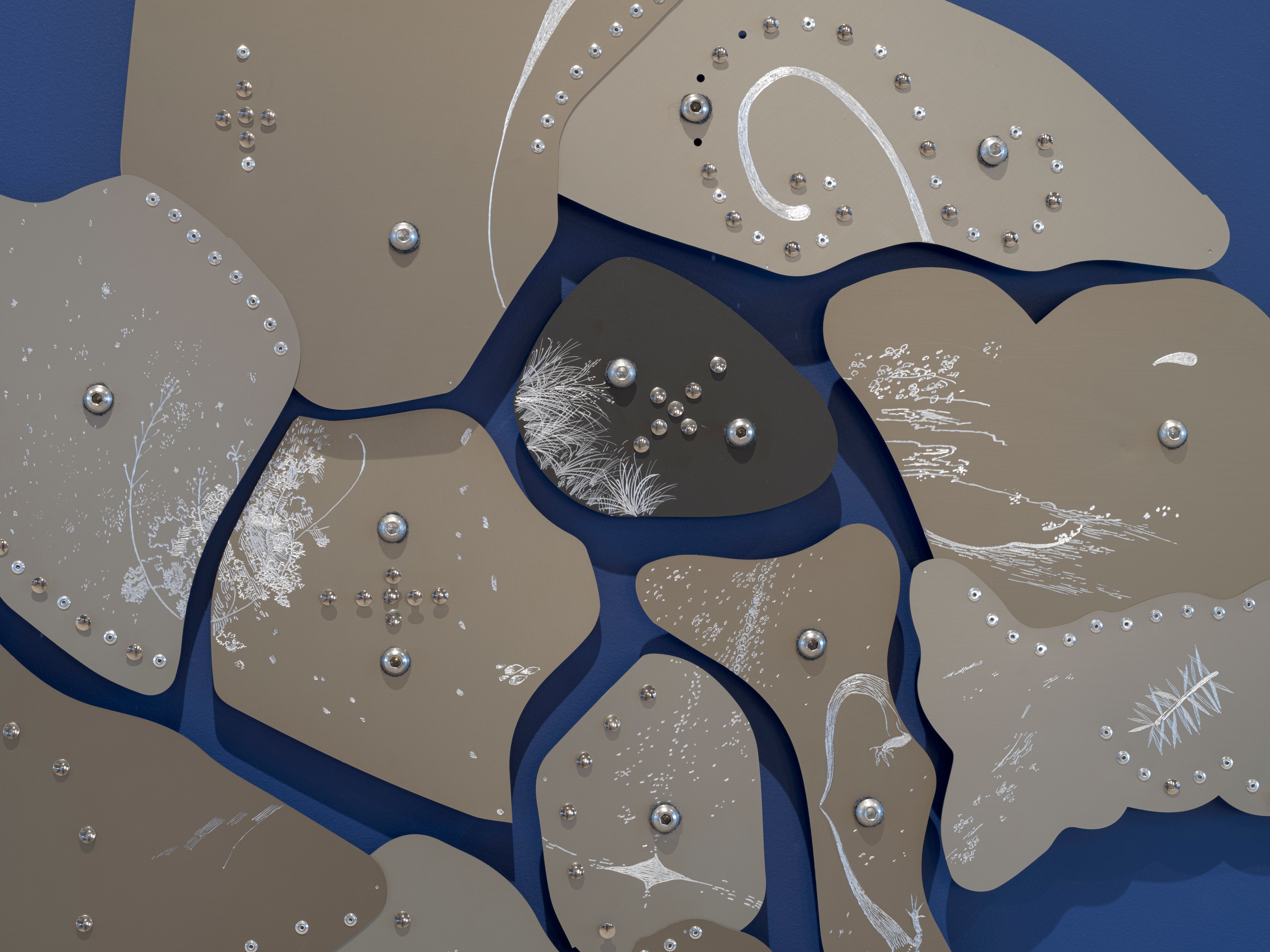\n*Madison Kelly, Walk wanawana walk (detail), 2024.*\n\nKelly invites you to explore a tactile experience of the features Waikirikiri Selwyn’s reptilian habitats; the Tī Kouka tree’s flowers, tussocks providing sustenance, sun-warmed river stones, and the vital water’s edge. It highlights the importance of Selwyn’s braided rivers and their margins—key habitats for native geckos and skinks threatened by environmental changes.\n\nIn te ao Māori, mokomoko are kaitiaki, or guardians, of their environments. In ecology, they serve as bioindicators of ecosystem health; their presence indicates that their ecosystem is healthy while their absence indicates that ecosystem is struggling. Kelly underscores the interconnectedness of waterways and the diverse life they sustain, reminding us that these ecosystems are deeply intertwined whakapapa. \n \n \n**Glossary of Māori Terms**\n\nKupu Māori - Māori word\n\nMihi – acknowlegement\n\nAtua - deity, ancestor with continuing influence\n\nTe ao Maōri - the Maōri world\n\nTī Kouka – Cabbage tree\n\nMokomoko – native lizards\n\nWhakapapa - genealogy\n","BodyMaori":null,"Credit":"Photograph by John Collie","MediaCaption":"Steven Junil Park, *Room* (installation view), 2023. Mixed media installation. ","Title":"Madison Kelly, Walk wanawana walk, 2024","TitleMaori":null,"PlayIconStyle":null,"id":418,"Media":{"localFile":{"publicURL":"/static/e211b14ad6a7c50bb1eaff281e6cd58e/Te_Ara_A_aetea_Sculpture_0238_31a977ee24.jpg"},"mime":"image/jpeg"},"VideoPlaceholderImage":null},{"Body":"*Between tide and time*, 2023 \nMegan Brady (Kāi Tahu, Ngāi Tūāhuriri, Pākehā) \nSteel, linen \nCourtesy of the artist \n\nMegan Brady is on a journey to reconnect with her home. After discovering her Ngāi Tūāhuriri whakapapa, she has been spending time on her tūrakawaewae in and around Ōtautahi Christchurch. *Between tide and time* considers the tide, which wraps around the coast from the Rakahuri Ashley awa to Taumutu, as a site of connection. This tide, Te Tai o Mahaanui, connects the marae of Ngāi Tūāhuriri to Ngāi Te Ruahikihiki ki Taumutu, mana whenua of Waikirikiri Selwyn.\n \nThe steel structure traces the distinctive curve of Te Pātaka o Rākaihautū Banks Peninsula and supports seven lengths of linen, suspended from tracings of pōhatu Brady collected along the shoreline. The six breaks between the fabric indicate where different hapū are located along the coast, a mihi to Brady’s whanauka and the interconnected network of Kāi Tahu hapū. For Brady, home is found in identity and connection with others, as well as a physical place. \n\nThe threads removed from the fabric create a repeating pattern which depicts the cycles of water. Beginning with the tide of Mahaanui, clouds form over the ocean and rain falls on the mountains before moving through the rivers and returning to the sea. This pattern was inspired by the poem ‘The River is an Island’, written by Hone Tuwhare, a favourite poet of Brady and her father. In Te Ara Ātea, *Between tide and time* ebbs and flows not with the tide, but with the changing sunlight and the movement of people who spend time with it.\n\n**Glossary of Māori terms** \n\nWhakapapa – genealogy \n\nTūrakawaewae - a place where one has rights of residence and belonging through kinship and whakapapa. \n\nAwa – river \n\nPōhatu- rocks \n\nHapū - kinship group, subtribe \n\nMihi – Acknowledgement \n\nWhanauka – relative, kin \n \n*With thanks to Te Tai o Mahaanui, Pete Brady, Brady whānau, Henry Francis, Puamiria Parata-Goodall, Denise Sheat, Chloe Cull, Ollie Roake, Bella Roake, Paige Jansen, Alix Ashworth, Ngaio Cowell, Orissa Keane, Ray Moreton, Steve Trevella, Rob Palmer, Peter Nock, Paemanu Ngāi Tahu Contemporary Visual Art*","BodyMaori":null,"Credit":"Photograph by Kelly Shakespeare","MediaCaption":"Megan Brady, *Between tide and time* (installation view), 2023. Steel, linen.","Title":"Megan Brady, Between tide and time, 2023","TitleMaori":null,"PlayIconStyle":null,"id":416,"Media":{"localFile":{"publicURL":"/static/b720625b98102a5ebc13d374a1cd0e5d/Portrait_Te_Ara_Atea_Home_Exhibition_8436_2_d0d56d7651.jpg"},"mime":"image/jpeg"},"VideoPlaceholderImage":null},{"Body":"*Te āhua o te wai | The em[Body]ment of Water*, 2024 \nTia Barrett (Ngāi Tahu, Ngāti Mamoe, Te Rapuwai, Waitaha, Ngāti Maniapoto, Ngāti Tamainupō) \nDigital video (6 mins) and mōteatea \nCourtesy of the artist \n \n“I want to invite viewers to contemplate our relationship with ngā whenua me ngā wai and the responsibilities inherent in its protection.” - Tia Barrett \n\n*Te āhua o te wai | The em[Body]ment of Water* is a moving image artwork paired with a mōteatea created and composed by artist Tia Barrett whose whakapapa connects her to Te Roto o Wairewa Lake Forsyth. Barrett filmed at both Wairewa Lake Forsyth and Te Waihora Lake Ellesmere with permission from mana whenua. The em[Body]ment of Water begins with soft waves gently rolling over submarine footage, framed by river stones, shifting to locations of significance and connection points. \n\n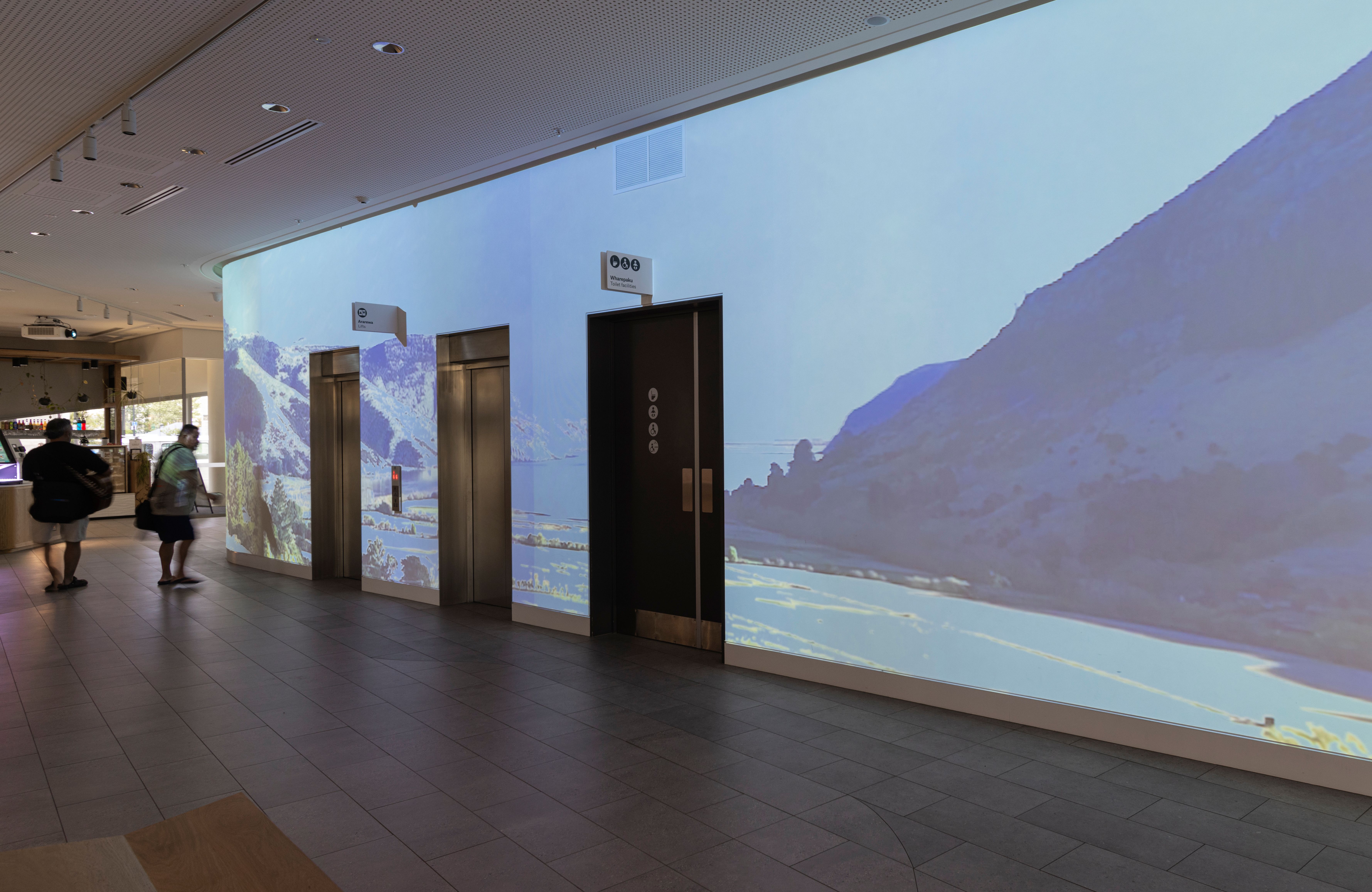\n*Tia Barrett, Te āhua o te wai | The em[Body]ment of Water (installation view), 2024.*\n\nThe intention for *The em[Body]ment of Water* is to reflect the hope of healing and protection for this body of water. Barrett focuses on the increasing strength of mauri and health of the lake while also acknowledging the impact of environmental damage that results from colonisation and climate change. The artwork provides a visual reminder of the achievements of aspirational restoration projects that are improving the health of the lake.\n\nBarrett describes the mōteatea,* Te āhua o te wai*, as ‘he karakia, he karanga, he waiata aroha’ which translates to a incantation/prayer, a call, a song of love. It speaks to positivity and hope and invisons abundance for future generations. Every time this mōteatea is heard or preformed it will envoke a healing process that will narrate wellbeing back into these lands and waterways. \n\n\n**Glossary for Māori Terms**\n\nMōteatea – traditional chant, lament\n\nNgā whenua me ngā wai - the land and the water\n\nWhakapapa – geneology\n\nMauri – life force\n\nKā roto – the lake, the wetlands\n\nManu whenua - Māori who have ancestral claims and territorial rights over a particular area\n \n \n*The artist would like to acknowledge her Ngāti Irakehu o Wairewa whānui, and Ngāi Te Ruahikihiki o Taumutu, mana whenua for Waikirikiri Selwyn.* \n \n*With thanks to Puamiria Parata-Goodall, Matiu Prebble and his tauira at Canterbury University, Paemanu - Ngai Tahu Contemporary Visual Arts, Caitlin Rose Donnelly, the artist’s whānau Nadia Maddock, Richard Hinks and their children Macey, Ollie and Hattie, the artist’s mother Dr Alvina Jean Edwards, the artist’s brother Tui Tuwairua Barrett and his daughter Ngākauri-Kaihou Ropata Barrett, Zena Elliott and the Ereatara Whānau.*","BodyMaori":null,"Credit":"Photograph by John Collie","MediaCaption":"Tia Barrett, *Te āhua o te wai | The em[Body]ment of Water* (installation view), 2024.","Title":"Tia Barrett, Te āhua o te wai | The em[Body]ment of Water, 2024","TitleMaori":null,"PlayIconStyle":null,"id":417,"Media":{"localFile":{"publicURL":"/static/8c1b24f340441d7dd3a33d62559b16a6/Te_Ara_Atea_4060_1_44872be778.jpg"},"mime":"image/jpeg"},"VideoPlaceholderImage":null},{"Body":"\n\n*Tongatapu (Full Moon)*, 2019, Photographic print, UC-APC-1325, University of Canterbury Art Collection \n*Tauranga Moana (Dusk)*, 2021, Photographic print, UC-APC-1325, University of Canterbury Art Collection \nEmily Parr (Ngāi Te Rangi, Moana, Pākehā) \n35mm film (digital scan) \nCourtesy of the University of Canterbury Art Collection \n\n\n“You see, it is not just the whales who, for generations upon generations, have followed these ancient oceanic pathways and formed webs of relations between fixed points. These are my ancestral legacies, too.” - Emily Parr\n\n\nDuring Emily Parr’s Masters research at AUT University, she reconnected with her ancestral homelands on haerenga to Samoa, Tonga, and Tauranga Moana. Though, it might be more accurate to say that she reconnected with her ancestral homewaters.\n\nParr describes herself as a descendent of settler-indigenous relationships across Te Moana-nui-a-Kiwa. The journeys of her European male ancestors have been well documented but the stories of the women they married when they reached the pacific are largely unknown. In an effort to get to know the indigenous women Parr descends from, she returned to their waters, traversing Te Moana-nui-a-Kiwa as her ancestors did for generations.\n\nWhile on this haerenga, Parr retraced these migration lines of her ancestors. In doing so, Parr also traced the migration of paikea, southern humpback whales, that travel from Antarctica along the eastern coast of Aotearoa New Zealand to reach the warm waters of the Pacific to breed. Parr’s whakapapa is tied to these whales through an ancestor she shares with Ngāi Tahu, Paikea, who was known for riding a humpback whale.\n\nTo capture these layers of whakapapa and connection, Parr used film photography because of its ability to capture wairua when the image is made from the traces light leaves on a negative. In these photographs Parr shows us a view of Te Moana-nui-a-Kiwa, the Pacific Ocean, as a space that connects islands and people rather than isolating them from each other.\n\n**Glossary of Māori Words**\n\nTe Moana-nui-a-Kiwa – the Pacific Ocean\n\nHaeranga – journeys\n\nWhakapapa - genealogy\n\nWairua – spirit","BodyMaori":null,"Credit":"Photograph by John Collie","MediaCaption":"Emily Parr,* Tongatapu (Full Moon)*, 2019 and* Tauranga Moana (Dusk)*, 2021 (installation view).","Title":"Emily Parr, Tongatapu (Full Moon), 2019 and Tauranga Moana (Dusk), 2021","TitleMaori":null,"PlayIconStyle":null,"id":413,"Media":{"localFile":{"publicURL":"/static/d30dfddf46a325a83ba5f52aa3f9d1a3/Te_Ara_A_aetea_Sculpture_0243_8a1a409a67.jpg"},"mime":"image/jpeg"},"VideoPlaceholderImage":null},{"Body":"*Rivers to Ocean,* 2023 \nPauline Rhodes \nMixed media installation \nCourtesy of the artist \n\nPauline Rhodes has always been preoccupied with the health of our waterways. In *Rivers to Ocean* Rhodes brings together an abstract installation of paintings on canvas, stained plywood and textiles to ‘draw attention to our oceans and rivers and encourage an awareness of their value to all life on earth’.\n\nAfter being introduced to the geology department while at University of Canterbury School of Fine Arts in the early 1970s, Rhodes has had an enduring interest in the geological history of Waitaha, the Canterbury Plains, and Horomaka, Banks Peninsula. In geological time, the area that is now Waikirikiri Selwyn, was once under the ocean. As Rhodes recalls, ‘in that period, even before the land of the plains was built up by the rivers flowing down from the Alpine Ranges, the sea surrounded Horomaka Banks Peninsula.\n \nThis Island was formed between eleven and eight million years ago by the eruptions of two volcanoes. More recently the unique braided rivers of what is now the plains have been rapidly changed by human habitation.’\n\nThe fabric that flows through the cases have been repeatedly used by Rhodes in her fleeting interventions in the intertidal zone, an area she has worked with since 1972. In Te Ara Ātea, the textiles now wind their way around and over *River Flow* panels of stained ply, reflecting Rhodes’ ‘ongoing concern for the state of the oceans of the world and for the rivers which flow into them’. \n\n **List of works**\n\nPauline Rhodes, *Oceans 1,* 2024, acrylic on canvas \nPauline Rhodes, *Oceans 2*, 2024, acrylic on canvas \nPauline Rhodes, *Oceans 3,* 2024, acrylic on canvas \nPauline Rhodes, *Oceans 4*, 2024, acrylic on canvas \nPauline Rhodes, *Oceans 5*, 2024, acrylic on canvas \nPauline Rhodes, *River Flows*, 1990s, stained plywood, linen, silk, wool \n\n\n\n \n\n ","BodyMaori":null,"Credit":"Photograph by John Collie","MediaCaption":"Pauline Rhodes, *Rivers to Ocean* (installation view), 2023. Mixed media installation.\n","Title":"Pauline Rhodes, Rivers to Ocean, 2023","TitleMaori":null,"PlayIconStyle":null,"id":414,"Media":{"localFile":{"publicURL":"/static/43ddbe4cf3bb9d0c5e16c3240b04ac99/Pauline_Rhodes_1013_Pano_62de96c8fb.jpg"},"mime":"image/jpeg"},"VideoPlaceholderImage":null},{"Body":"*Te Hono Ki Waihora*, 1990 \nJohn Bevan Ford (Ngāti Raukawa ki Kapiti) \nInk on paper \nCourtesy of the Lincoln University Art Collection \n\n*‘Sometimes like a mist enveloping the island, and eventually as if the cloak of some invisible elder were drifting above the land and sea, a symbol of mana lifted up as it were, making room for us all. A cloak to warm us, to bind us, to spiritually enfold us.’*- John Bevan Ford\n\n*Te Hono Ki Waihora* is part of the *Te Hono* or Connection series by artist John Bevan Ford. Ford grew up in Leeston until he was ten years old and chose to include the lake of his boyhood, Te Waihora Lake Ellesmere, years later when reflecting on significant landscapes of Aotearoa New Zealand.\n\nFord described the kākahu motif in this series as ‘one of the great symbols of mana’. Floating above Te Waihora is a kaitaka, one of the most prestigious types of cloaks reserved for rakatira because it required technical mastery and the highest quality of muka. \n\nIn the cloak that Ford has created, the pattern used to create the kaupapa, the main body of the kākahu, is the same that fills the hills and the lakeside below. The kaupapa of kaitaka is formed by tightly weaving fibres together to create a sturdy fabric. By using the same pattern in the landscape of Te Waihora Lake Ellesmere and the Port Hills, Ford emphasises that the people who live in this landscape are tightly woven together as well. \n \nUnder the floating kākahu sits Te Waihora is filled with countless colourful threads that converge the middle of the lake. By portraying Te Waihora Lake Ellesmere in this way, Ford creates a visual depiction of the mana held by Ngāi Te Ruahikihiki ki Taumutu over this body of water and the hono, connections, it has to those who live on its shores. \n\n**Glossary for Māori Terms** \nMana – prestige, spiritual power \nKākahu – cloak \nKaitaka – a highly prized cloak made of flax fibre with a tāniko ornamental border \nRakatira – chief \nMuka – prepared flax fibre \n","BodyMaori":null,"Credit":"Photograph by John Collie","MediaCaption":"John Bevan Ford, *Te Hono Ki Waihora* (installation view), 1990. Ink on paper.","Title":"John Beven Ford, Te Hono Ki Waihora, 1990","TitleMaori":null,"PlayIconStyle":null,"id":419,"Media":{"localFile":{"publicURL":"/static/00f9b39b1b51850da7aa1ca302b4ef3c/Te_Ara_A_aetea_Sculpture_0240_d35c41c252.jpg"},"mime":"image/jpeg"},"VideoPlaceholderImage":null}],"Title":"DL03 Toi Arts 06- Undercurrents","id":"Slideshows_101","strapiId":101,"TimeoutOverrideSeconds":null}},"pageContext":{"id":"Slideshows_101","slideshowData":{"Slideshow":[{"Body":"What lies beyond our everyday encounters with water? How well do we see the stories that water holds? In Te Ara Ātea’s new art exhibition, *Undercurrents*, artists offer us a different way of seeing and thinking about our relationship to water in Waikirikiri Selwyn. Essential to life on Earth, there are endless thoughts and perspectives about water; Undercurrents includes just six of them. \n\n*Undercurrents* presents commissioned artworks by Tia Barrett, Megan Brady, Madison Kelly, and Pauline Rhodes alongside work by John Bevan Ford and Emily Parr on loan from the Lincoln University Art Collection and the University of Canterbury Art Collection. Each artist tells a story that prompts us to think about the many waters that surround us and the stories that flow beneath.\n ","BodyMaori":null,"Credit":"","MediaCaption":"Pauline Rhodes, *Rivers to Ocean* (detail), 2024.","Title":"Undercurrents","TitleMaori":null,"id":412,"PlayIconStyle":null,"Media":{"localFile":{"publicURL":"/static/de5c630601228a9e5528fcf823484f95/Pauline_Rhodes_Undercurrents_promo_image_47cd0e07f1.jpeg"},"mime":"image/jpeg"}},{"Body":"*Walk wanawana walk*, 2023 \nMadison Kelly (Kāi Tahu, Kāti Mamoe, Pākehā) \nAluminium, rivets, felt \nCourtesy of the artist \n \n \n‘The kupu Māori wanawana holds several meanings, including “shiver, trill, quiver, fear, thrill” ... the work is built around the sensory feedback of touch and vibration to emulate a taniwha-like “shiver and hiss” installation watching over (and calling out to) visitors of Te Ara Ātea.’ - Madison Kelly\n\nMadison Kelly’s interactive installation, *Walk wanawana walk*, provides a sensory experience of “wanawana”. Depicting the scale pattern of the Canterbury Grass Skink’s head and eye, the installation features metallic scales etched with detailed field drawings from Selwyn’s waterways alongside illustrations of skinks and their habitats. The metallic scales are punctured with rivets and reference sizzle symbols that drummers use to create rattling and hissing sound. This experience is a mihi to hiss and scuttle of the atua of reptiles, Tūtewanawana, whose grandfather is Takaroa, atua of the sea. Reptiles in te ao Maōri are also connected to taniwha, guardians of bodies of water. In Waikirikiri Selwyn, Te Waihora Lake Ellesmere is home to the taniwha Tūterakiwhanoa.\n\n\n*Madison Kelly, Walk wanawana walk (detail), 2024.*\n\nKelly invites you to explore a tactile experience of the features Waikirikiri Selwyn’s reptilian habitats; the Tī Kouka tree’s flowers, tussocks providing sustenance, sun-warmed river stones, and the vital water’s edge. It highlights the importance of Selwyn’s braided rivers and their margins—key habitats for native geckos and skinks threatened by environmental changes.\n\nIn te ao Māori, mokomoko are kaitiaki, or guardians, of their environments. In ecology, they serve as bioindicators of ecosystem health; their presence indicates that their ecosystem is healthy while their absence indicates that ecosystem is struggling. Kelly underscores the interconnectedness of waterways and the diverse life they sustain, reminding us that these ecosystems are deeply intertwined whakapapa. \n \n \n**Glossary of Māori Terms**\n\nKupu Māori - Māori word\n\nMihi – acknowlegement\n\nAtua - deity, ancestor with continuing influence\n\nTe ao Maōri - the Maōri world\n\nTī Kouka – Cabbage tree\n\nMokomoko – native lizards\n\nWhakapapa - genealogy\n","BodyMaori":null,"Credit":"Photograph by John Collie","MediaCaption":"Steven Junil Park, *Room* (installation view), 2023. Mixed media installation. ","Title":"Madison Kelly, Walk wanawana walk, 2024","TitleMaori":null,"id":418,"PlayIconStyle":null,"Media":{"localFile":{"publicURL":"/static/e211b14ad6a7c50bb1eaff281e6cd58e/Te_Ara_A_aetea_Sculpture_0238_31a977ee24.jpg"},"mime":"image/jpeg"}},{"Body":"*Between tide and time*, 2023 \nMegan Brady (Kāi Tahu, Ngāi Tūāhuriri, Pākehā) \nSteel, linen \nCourtesy of the artist \n\nMegan Brady is on a journey to reconnect with her home. After discovering her Ngāi Tūāhuriri whakapapa, she has been spending time on her tūrakawaewae in and around Ōtautahi Christchurch. *Between tide and time* considers the tide, which wraps around the coast from the Rakahuri Ashley awa to Taumutu, as a site of connection. This tide, Te Tai o Mahaanui, connects the marae of Ngāi Tūāhuriri to Ngāi Te Ruahikihiki ki Taumutu, mana whenua of Waikirikiri Selwyn.\n \nThe steel structure traces the distinctive curve of Te Pātaka o Rākaihautū Banks Peninsula and supports seven lengths of linen, suspended from tracings of pōhatu Brady collected along the shoreline. The six breaks between the fabric indicate where different hapū are located along the coast, a mihi to Brady’s whanauka and the interconnected network of Kāi Tahu hapū. For Brady, home is found in identity and connection with others, as well as a physical place. \n\nThe threads removed from the fabric create a repeating pattern which depicts the cycles of water. Beginning with the tide of Mahaanui, clouds form over the ocean and rain falls on the mountains before moving through the rivers and returning to the sea. This pattern was inspired by the poem ‘The River is an Island’, written by Hone Tuwhare, a favourite poet of Brady and her father. In Te Ara Ātea, *Between tide and time* ebbs and flows not with the tide, but with the changing sunlight and the movement of people who spend time with it.\n\n**Glossary of Māori terms** \n\nWhakapapa – genealogy \n\nTūrakawaewae - a place where one has rights of residence and belonging through kinship and whakapapa. \n\nAwa – river \n\nPōhatu- rocks \n\nHapū - kinship group, subtribe \n\nMihi – Acknowledgement \n\nWhanauka – relative, kin \n \n*With thanks to Te Tai o Mahaanui, Pete Brady, Brady whānau, Henry Francis, Puamiria Parata-Goodall, Denise Sheat, Chloe Cull, Ollie Roake, Bella Roake, Paige Jansen, Alix Ashworth, Ngaio Cowell, Orissa Keane, Ray Moreton, Steve Trevella, Rob Palmer, Peter Nock, Paemanu Ngāi Tahu Contemporary Visual Art*","BodyMaori":null,"Credit":"Photograph by Kelly Shakespeare","MediaCaption":"Megan Brady, *Between tide and time* (installation view), 2023. Steel, linen.","Title":"Megan Brady, Between tide and time, 2023","TitleMaori":null,"id":416,"PlayIconStyle":null,"Media":{"localFile":{"publicURL":"/static/b720625b98102a5ebc13d374a1cd0e5d/Portrait_Te_Ara_Atea_Home_Exhibition_8436_2_d0d56d7651.jpg"},"mime":"image/jpeg"}},{"Body":"*Te āhua o te wai | The em[Body]ment of Water*, 2024 \nTia Barrett (Ngāi Tahu, Ngāti Mamoe, Te Rapuwai, Waitaha, Ngāti Maniapoto, Ngāti Tamainupō) \nDigital video (6 mins) and mōteatea \nCourtesy of the artist \n \n“I want to invite viewers to contemplate our relationship with ngā whenua me ngā wai and the responsibilities inherent in its protection.” - Tia Barrett \n\n*Te āhua o te wai | The em[Body]ment of Water* is a moving image artwork paired with a mōteatea created and composed by artist Tia Barrett whose whakapapa connects her to Te Roto o Wairewa Lake Forsyth. Barrett filmed at both Wairewa Lake Forsyth and Te Waihora Lake Ellesmere with permission from mana whenua. The em[Body]ment of Water begins with soft waves gently rolling over submarine footage, framed by river stones, shifting to locations of significance and connection points. \n\n\n*Tia Barrett, Te āhua o te wai | The em[Body]ment of Water (installation view), 2024.*\n\nThe intention for *The em[Body]ment of Water* is to reflect the hope of healing and protection for this body of water. Barrett focuses on the increasing strength of mauri and health of the lake while also acknowledging the impact of environmental damage that results from colonisation and climate change. The artwork provides a visual reminder of the achievements of aspirational restoration projects that are improving the health of the lake.\n\nBarrett describes the mōteatea,* Te āhua o te wai*, as ‘he karakia, he karanga, he waiata aroha’ which translates to a incantation/prayer, a call, a song of love. It speaks to positivity and hope and invisons abundance for future generations. Every time this mōteatea is heard or preformed it will envoke a healing process that will narrate wellbeing back into these lands and waterways. \n\n\n**Glossary for Māori Terms**\n\nMōteatea – traditional chant, lament\n\nNgā whenua me ngā wai - the land and the water\n\nWhakapapa – geneology\n\nMauri – life force\n\nKā roto – the lake, the wetlands\n\nManu whenua - Māori who have ancestral claims and territorial rights over a particular area\n \n \n*The artist would like to acknowledge her Ngāti Irakehu o Wairewa whānui, and Ngāi Te Ruahikihiki o Taumutu, mana whenua for Waikirikiri Selwyn.* \n \n*With thanks to Puamiria Parata-Goodall, Matiu Prebble and his tauira at Canterbury University, Paemanu - Ngai Tahu Contemporary Visual Arts, Caitlin Rose Donnelly, the artist’s whānau Nadia Maddock, Richard Hinks and their children Macey, Ollie and Hattie, the artist’s mother Dr Alvina Jean Edwards, the artist’s brother Tui Tuwairua Barrett and his daughter Ngākauri-Kaihou Ropata Barrett, Zena Elliott and the Ereatara Whānau.*","BodyMaori":null,"Credit":"Photograph by John Collie","MediaCaption":"Tia Barrett, *Te āhua o te wai | The em[Body]ment of Water* (installation view), 2024.","Title":"Tia Barrett, Te āhua o te wai | The em[Body]ment of Water, 2024","TitleMaori":null,"id":417,"PlayIconStyle":null,"Media":{"localFile":{"publicURL":"/static/8c1b24f340441d7dd3a33d62559b16a6/Te_Ara_Atea_4060_1_44872be778.jpg"},"mime":"image/jpeg"}},{"Body":"\n\n*Tongatapu (Full Moon)*, 2019, Photographic print, UC-APC-1325, University of Canterbury Art Collection \n*Tauranga Moana (Dusk)*, 2021, Photographic print, UC-APC-1325, University of Canterbury Art Collection \nEmily Parr (Ngāi Te Rangi, Moana, Pākehā) \n35mm film (digital scan) \nCourtesy of the University of Canterbury Art Collection \n\n\n“You see, it is not just the whales who, for generations upon generations, have followed these ancient oceanic pathways and formed webs of relations between fixed points. These are my ancestral legacies, too.” - Emily Parr\n\n\nDuring Emily Parr’s Masters research at AUT University, she reconnected with her ancestral homelands on haerenga to Samoa, Tonga, and Tauranga Moana. Though, it might be more accurate to say that she reconnected with her ancestral homewaters.\n\nParr describes herself as a descendent of settler-indigenous relationships across Te Moana-nui-a-Kiwa. The journeys of her European male ancestors have been well documented but the stories of the women they married when they reached the pacific are largely unknown. In an effort to get to know the indigenous women Parr descends from, she returned to their waters, traversing Te Moana-nui-a-Kiwa as her ancestors did for generations.\n\nWhile on this haerenga, Parr retraced these migration lines of her ancestors. In doing so, Parr also traced the migration of paikea, southern humpback whales, that travel from Antarctica along the eastern coast of Aotearoa New Zealand to reach the warm waters of the Pacific to breed. Parr’s whakapapa is tied to these whales through an ancestor she shares with Ngāi Tahu, Paikea, who was known for riding a humpback whale.\n\nTo capture these layers of whakapapa and connection, Parr used film photography because of its ability to capture wairua when the image is made from the traces light leaves on a negative. In these photographs Parr shows us a view of Te Moana-nui-a-Kiwa, the Pacific Ocean, as a space that connects islands and people rather than isolating them from each other.\n\n**Glossary of Māori Words**\n\nTe Moana-nui-a-Kiwa – the Pacific Ocean\n\nHaeranga – journeys\n\nWhakapapa - genealogy\n\nWairua – spirit","BodyMaori":null,"Credit":"Photograph by John Collie","MediaCaption":"Emily Parr,* Tongatapu (Full Moon)*, 2019 and* Tauranga Moana (Dusk)*, 2021 (installation view).","Title":"Emily Parr, Tongatapu (Full Moon), 2019 and Tauranga Moana (Dusk), 2021","TitleMaori":null,"id":413,"PlayIconStyle":null,"Media":{"localFile":{"publicURL":"/static/d30dfddf46a325a83ba5f52aa3f9d1a3/Te_Ara_A_aetea_Sculpture_0243_8a1a409a67.jpg"},"mime":"image/jpeg"}},{"Body":"*Rivers to Ocean,* 2023 \nPauline Rhodes \nMixed media installation \nCourtesy of the artist \n\nPauline Rhodes has always been preoccupied with the health of our waterways. In *Rivers to Ocean* Rhodes brings together an abstract installation of paintings on canvas, stained plywood and textiles to ‘draw attention to our oceans and rivers and encourage an awareness of their value to all life on earth’.\n\nAfter being introduced to the geology department while at University of Canterbury School of Fine Arts in the early 1970s, Rhodes has had an enduring interest in the geological history of Waitaha, the Canterbury Plains, and Horomaka, Banks Peninsula. In geological time, the area that is now Waikirikiri Selwyn, was once under the ocean. As Rhodes recalls, ‘in that period, even before the land of the plains was built up by the rivers flowing down from the Alpine Ranges, the sea surrounded Horomaka Banks Peninsula.\n \nThis Island was formed between eleven and eight million years ago by the eruptions of two volcanoes. More recently the unique braided rivers of what is now the plains have been rapidly changed by human habitation.’\n\nThe fabric that flows through the cases have been repeatedly used by Rhodes in her fleeting interventions in the intertidal zone, an area she has worked with since 1972. In Te Ara Ātea, the textiles now wind their way around and over *River Flow* panels of stained ply, reflecting Rhodes’ ‘ongoing concern for the state of the oceans of the world and for the rivers which flow into them’. \n\n **List of works**\n\nPauline Rhodes, *Oceans 1,* 2024, acrylic on canvas \nPauline Rhodes, *Oceans 2*, 2024, acrylic on canvas \nPauline Rhodes, *Oceans 3,* 2024, acrylic on canvas \nPauline Rhodes, *Oceans 4*, 2024, acrylic on canvas \nPauline Rhodes, *Oceans 5*, 2024, acrylic on canvas \nPauline Rhodes, *River Flows*, 1990s, stained plywood, linen, silk, wool \n\n\n\n \n\n ","BodyMaori":null,"Credit":"Photograph by John Collie","MediaCaption":"Pauline Rhodes, *Rivers to Ocean* (installation view), 2023. Mixed media installation.\n","Title":"Pauline Rhodes, Rivers to Ocean, 2023","TitleMaori":null,"id":414,"PlayIconStyle":null,"Media":{"localFile":{"publicURL":"/static/43ddbe4cf3bb9d0c5e16c3240b04ac99/Pauline_Rhodes_1013_Pano_62de96c8fb.jpg"},"mime":"image/jpeg"}},{"Body":"*Te Hono Ki Waihora*, 1990 \nJohn Bevan Ford (Ngāti Raukawa ki Kapiti) \nInk on paper \nCourtesy of the Lincoln University Art Collection \n\n*‘Sometimes like a mist enveloping the island, and eventually as if the cloak of some invisible elder were drifting above the land and sea, a symbol of mana lifted up as it were, making room for us all. A cloak to warm us, to bind us, to spiritually enfold us.’*- John Bevan Ford\n\n*Te Hono Ki Waihora* is part of the *Te Hono* or Connection series by artist John Bevan Ford. Ford grew up in Leeston until he was ten years old and chose to include the lake of his boyhood, Te Waihora Lake Ellesmere, years later when reflecting on significant landscapes of Aotearoa New Zealand.\n\nFord described the kākahu motif in this series as ‘one of the great symbols of mana’. Floating above Te Waihora is a kaitaka, one of the most prestigious types of cloaks reserved for rakatira because it required technical mastery and the highest quality of muka. \n\nIn the cloak that Ford has created, the pattern used to create the kaupapa, the main body of the kākahu, is the same that fills the hills and the lakeside below. The kaupapa of kaitaka is formed by tightly weaving fibres together to create a sturdy fabric. By using the same pattern in the landscape of Te Waihora Lake Ellesmere and the Port Hills, Ford emphasises that the people who live in this landscape are tightly woven together as well. \n \nUnder the floating kākahu sits Te Waihora is filled with countless colourful threads that converge the middle of the lake. By portraying Te Waihora Lake Ellesmere in this way, Ford creates a visual depiction of the mana held by Ngāi Te Ruahikihiki ki Taumutu over this body of water and the hono, connections, it has to those who live on its shores. \n\n**Glossary for Māori Terms** \nMana – prestige, spiritual power \nKākahu – cloak \nKaitaka – a highly prized cloak made of flax fibre with a tāniko ornamental border \nRakatira – chief \nMuka – prepared flax fibre \n","BodyMaori":null,"Credit":"Photograph by John Collie","MediaCaption":"John Bevan Ford, *Te Hono Ki Waihora* (installation view), 1990. Ink on paper.","Title":"John Beven Ford, Te Hono Ki Waihora, 1990","TitleMaori":null,"id":419,"PlayIconStyle":null,"Media":{"localFile":{"publicURL":"/static/00f9b39b1b51850da7aa1ca302b4ef3c/Te_Ara_A_aetea_Sculpture_0240_d35c41c252.jpg"},"mime":"image/jpeg"}}],"Title":"DL03 Toi Arts 06- Undercurrents","id":"Slideshows_101","strapiId":101},"homePath":"/touchscreens/DL03","backPath":"/touchscreens/DL03/menu/26","title":"DIGITAL LABEL 03
Digital Label Title 03","showLanguageButtons":null,"styles":"html,body {\n font-family: Gotham;\n height: 100%;\n margin: 0px;\n padding: 0px;\n}\n\n* {\n -webkit-user-select: none;\n -khtml-user-select: none;\n -moz-user-select: none;\n -o-user-select: none;\n user-select: none;\n}\n\nh1 {\n color: #231f20;\n margin: -20px 0 0 0;\n font-family: 'IndustryIncInline';\n font-size: 80px;\n text-transform: uppercase;\n}\n\nh3 {\n color: #231f20;\n font-size: 12px;\n text-transform: uppercase;\n line-height: 2em;\n}\n\nh3.subpage-touchscreen-title {\n font-family: 'DIN2014';\n font-size: 20px;\n text-transform: uppercase;\n margin-top: -18px;\n}\n\na {\n text-decoration: none;\n}\n\n.menu-page-icon-container h1, .touchscreen-menu-items-container h1 {\n width: 900px;\n min-height: 2em;\n}\n\n.menu-page-icon-container.with-sidebar h1 {\n width: auto !important;\n}\n\n.page-container {\n margin: 0;\n padding: 70px 100px 0;\n position: relative;\n height: 100%;\n background: #ebebeb;\n}\n\nmain {\n width: 1920px;\n height: 1080px;\n}\n\n.hidden {\n display: none;\n}\n\n.nav {\n position: absolute;\n top: 60px;\n left: 0;\n z-index: 999;\n}\n\n.nav div, .nav a {\n display: block;\n width: 80px;\n height: 80px;\n float: left;\n}\n\n.nav .home {\n background: url(\"/SVG/Buttons/btn_home_light.svg\");\n}\n\n.nav .back {\n background: url(\"/SVG/Buttons/btn_arrow_prev.svg\");\n}\n\n.zoom-btn, .zoom-btn-fixed {\n display: block;\n width: 80px;\n height: 80px;\n position: absolute;\n top: 60px;\n right: 0;\n z-index: 999;\n background: url(\"/SVG/Buttons/btn_zoom_light.svg\");\n}\n\n.zoom-btn-fixed {\n right: 576px;\n}\n\n.play-btn {\n display: block;\n width: 80px;\n height: 80px;\n position: absolute;\n top: 50%;\n right: 50%;\n z-index: 999;\n background: url(\"/SVG/Buttons/btn_play.svg\");\n margin-right: -40px;\n margin-top: -40px;\n}\n\n.play-btn-audio {\n display: block;\n width: 80px;\n height: 80px;\n position: absolute;\n z-index: 999;\n background: url(\"/SVG/Buttons/btn_Audio.svg\");\n}\n\n.fancybox-button--close, .fancybox-close-small {\n position: fixed !important;\n width: 80px !important;\n height: 80px !important;\n background: url(\"/SVG/Buttons/btn_close.svg\") !important;\n}\n\n.fancybox-button--close svg, .fancybox-close-small svg {\n display: none !important;\n}\n\n.fancybox-button--zoom {\n display: none !important;\n}\n\n.fancybox-toolbar {\n width: 80px;\n}\n\n.video-js {\n background-color: #212121 !important;\n}\n\n.bg-div {\n background-size: cover !important;\n}\n\n.bg-video {\n position: fixed;\n right: 0;\n bottom: 0;\n min-width: 100%;\n min-height: 100%;\n z-index: 1;\n transition: 1s;\n}\n\n.halfFade {\n opacity: 0.2;\n}\n\n.touchscreen-page {\n background-color: #ebebeb00;\n}\n\n.touchscreen-page .nav {\n opacity: 0;\n transition: 1s;\n}\n\n.fadeIn {\n opacity: 1 !important;\n}\n\n.touchscreen-menu-items-container {\n transition: 1s;\n position: absolute;\n left: 1920px;\n top: 0;\n width: 1920px;\n height: 1080px;\n z-index: 100;\n}\n\n.touchscreen-menu-items-container-slide-in {\n left: 0;\n}\n\n.touchscreen-menu-items {\n z-index: 100;\n position: relative;\n width: 1720px;\n text-align: center;\n}\n\n.touchscreen-menu-items a {\n width: 600px;\n height: 600px;\n max-width: 600px;\n max-height: 600px;\n display: inline-block;\n margin: 90px 4px 0;\n}\n\n.touchscreen-menu-items a img {\n max-width: 600px;\n max-height: 600px;\n filter: grayscale(100%);\n}\n\n.touchscreen-menu-items a p {\n text-transform: uppercase;\n margin: 0;\n font-family: \"DIN2014\";\n width: 600px;\n padding: 10px;\n color: #231f20;\n white-space: nowrap;\n position: absolute;\n bottom: 0px;\n background-color: rgba(208, 210, 211, 0.8);\n height: 50px;\n text-align: left;\n bottom: 3px;\n}\n\n.touchscreen-text {\n transition: 1s;\n position: relative;\n left: 0;\n z-index: 100;\n}\n\n.touchscreen-text-slide-out {\n left: -1920px;\n}\n\n.touchscreen-text h1 {\n font-size: 160px;\n margin: 0;\n}\n\n.touchscreen-text h3 {\n font-size: 32px;\n font-weight: 200;\n padding-left: 20px;\n}\n\n.menu-page-items {\n height: 760px;\n position: relative;\n}\n\n.with-sidebar .menu-page-items {\n height: 870px !important;\n}\n\n.vertical-align {\n/* Center slide text vertically */\n \n\n\n display: -webkit-box;\n display: -ms-flexbox;\n display: -webkit-flex;\n display: flex;\n -webkit-box-pack: center;\n -ms-flex-pack: center;\n -webkit-justify-content: center;\n justify-content: center;\n -webkit-box-align: center;\n -ms-flex-align: center;\n -webkit-align-items: center;\n align-items: center;\n}\n\n.menu-page-infobox {\n display: none;\n}\n\n.menu-page-icon-container {\n color: #fff;\n width: 1820px;\n}\n\n.with-sidebar .menu-page-items-container {\n width: 1244px !important;\n}\n\n.menu-page-sidebar .swiper-zoom-container {\n position: relative;\n}\n\n.menu-page-sidebar .play-btn {\n left: auto !important;\n top: auto !important;\n right: auto !important;\n}\n\n.menu_item {\n position: relative;\n float: left;\n min-height: 1px;\n width: 340px;\n margin: 5px;\n}\n\n.menu_item img {\n filter: sepia(0) grayscale(100%);\n transition: .3s ease-in-out;\n display: block;\n width: 100%;\n max-width: none;\n height: 100%;\n object-fit: cover;\n}\n\n.menu_item p {\n text-transform: uppercase;\n margin: 0;\n font-family: \"DIN2014\";\n width: 100%;\n padding: 10px;\n color: #231f20;\n white-space: nowrap;\n position: absolute;\n bottom: 0;\n background-color: rgba(208, 210, 211, 0.9);\n min-height: 50px;\n}\n\n.menu_item.active p {\n background-color: rgba(255, 255, 255, 0.9);\n}\n\n.menu_item.active img {\n filter: sepia(75%) grayscale(0) !important;\n}\n\n.menu-page-icon-container.with-sidebar .menu_item {\n width: 270px;\n}\n\n.menu-page-icon-container {\n width: auto;\n}\n\n.main-slide {\n width: 100%;\n height: 100%;\n}\n\n.main-slide img {\n max-width: 80% !important;\n max-height: 910px !important;\n box-shadow: 3px 2px 20px 0px rgba(0, 0, 0, 0.2);\n}\n\n.video-fullscreen {\n width: 1820px;\n background: transparent !important;\n}\n\n.swiper-container {\n margin: 0 !important;\n background: rgb(235, 235, 235);\n}\n\n.swiper-main {\n width: 70%;\n height: 88%;\n position: absolute;\n left: 0px;\n top: 0;\n}\n\n.vjs-tech {\n pointer-events: none;\n}\n\n\n\n/* .fancybox-bg {background:lightgrey !important;} */\n\n\n\n.swiper-infobox {\n width: 30%;\n height: 100%;\n position: absolute !important;\n right: 0;\n top: 0;\n}\n\n.swiper-infobox .infobox h3 {\n margin-top: 200px;\n font-size: 32px;\n font-family: \"DIN2014\";\n letter-spacing: 0.1em;\n line-height: 1em;\n}\n\n.swiper-infobox .infobox {\n max-width: 410px;\n margin-left: 30px;\n font-weight: 100;\n}\n\n.swiper-infobox .infobox img {\n width: 100%;\n}\n\n.swiper-infobox .infobox .text {\n height: 590px;\n overflow: auto;\n padding-right: 10px;\n}\n\n.menu-page-sidebar .text {\n height: 860px !important;\n ;\n}\n\n::-webkit-scrollbar {\n width: 5px;\n height: 5px;\n}\n\n::-webkit-scrollbar-track {\n background: rgba(0, 0, 0, 0.1);\n}\n\n::-webkit-scrollbar-thumb {\n background: rgba(0, 0, 0, 0.5);\n}\n\n.swiper-scrollbar {\n height: 6px;\n}\n\n.swiper-caption {\n width: 70%;\n height: 12%;\n position: absolute;\n left: 0px;\n bottom: 0px;\n}\n\n.swiper-caption .caption {\n position: absolute;\n left: 30px;\n top: 10px;\n font-weight: 200;\n text-align: left;\n font-size: 14px;\n max-width: 650px;\n line-height: 1;\n}\n.swiper-caption .credit {\n position: absolute;\n left: 30px;\n top: 60px;\n}\nblockquote, .swiper-caption .credit {\n font-weight: 100;\n ;\n text-align: left;\n font-size: 12px;\n max-width: 650px;\n line-height: 1;\n}\nblockquote {margin: 0 !important;}\n\n.swiper-scrollbar {\n border-radius: 10px;\n position: relative;\n -ms-touch-action: none;\n background: rgba(0, 0, 0, .1);\n}\n\n.swiper-container > .swiper-scrollbar {\n top: 0 !important;\n position: absolute;\n left: 1%;\n bottom: 3px;\n z-index: 50;\n height: 5px;\n width: 98%;\n}\n\n.main-slide {\n text-align: center;\n font-size: 18px;\n background: rgb(235, 235, 235);\n/* Center slide text vertically */\n \n\n\n display: -webkit-box;\n display: -ms-flexbox;\n display: -webkit-flex;\n display: flex;\n -webkit-box-pack: center;\n -ms-flex-pack: center;\n -webkit-justify-content: center;\n justify-content: center;\n -webkit-box-align: center;\n -ms-flex-align: center;\n -webkit-align-items: center;\n align-items: center;\n}\n\n.main-slide .media {\n width: 100%;\n max-height: 910px;\n}\n\n.swiper-button-prev {\n background: url(\"/SVG/Buttons/btn_arrow_prev.svg\");\n left: auto !important;\n right: 81px !important;\n}\n\n.swiper-button-next {\n background: url(\"/SVG/Buttons/btn_arrow_next.svg\");\n right: 0 !important;\n}\n\n.swiper-button-prev, .swiper-button-next {\n width: 80px !important;\n height: 80px !important;\n font-weight: bold;\n position: absolute !important;\n top: 30px !important;\n}\n\n.swiper-button-prev:after, .swiper-button-next:after {\n content: \"\" !important;\n}\n\n.swiper-pagination-fraction {\n font-family: 'IndustryIncInline';\n left: 30px !important;\n bottom: 50px !important;\n text-align: left !important;\n font-size: 50px;\n}\n\n.my-shuffle {\n position: relative;\n overflow: hidden;\n top: 20px;\n/* padding-bottom:100%; */\n \n}\n\n\n/* default styles so shuffle doesn't have to set them (it will if they're missing) */\n.my-shuffle {\n position: relative;\n overflow: hidden;\n}\n\n/* Ensure images take up the same space when they load */\n/* https://vestride.github.io/Shuffle/images */\n.aspect {\n position: relative;\n width: 100%;\n height: 0;\n padding-bottom: 100%;\n overflow: hidden;\n}\n\n.aspect__inner {\n position: absolute;\n top: 0;\n right: 0;\n bottom: 0;\n left: 0;\n}\n\n\n/* img {\n display: block;\n width: 100%;\n max-width: none;\n height: 100%;\n object-fit: cover;\n} */\n\n/* Small reset */\n\n*,\n::before,\n::after {\n box-sizing: border-box;\n}\n\nfigure {\n margin: 0;\n padding: 0;\n}\n\n.menu-page-items-container {\n overflow-x: auto;\n}\n\n.fancybox-toolbar {\n visibility: visible !important;\n opacity: 1.0 !important;\n}\n\nvideo::-webkit-media-controls-overlay-play-button,\nvideo::-webkit-media-controls-volume-slider-container,\nvideo::-webkit-media-controls-mute-button,\nvideo::-webkit-media-controls-volume-slider,\nvideo::-webkit-media-controls-fullscreen-button,\nvideo::-webkit-media-controls-play-button,\nvideo::-webkit-media-controls-pausebutton {\n display: none;\n}\n\n.menu-page-20 .menu_item {\n width: 600px;\n}\n\n\n.menu-page-20 .menu-page-items {\n width: 1500px !important;\n position: absolute;\n top: 275px;\n left: 350px;\n}\n\n.menu-page-23 .menu_item {\n width: 600px;\n}\n\n\n.menu-page-23 .menu-page-items {\n width: 1500px !important;\n position: absolute;\n top: 275px;\n left: 350px;\n}\n\n.menu-page-15 .menu-page-items-container {\n overflow-x: auto;\n position: absolute;\n top: 180px;\n}\n\n.menu-page-19 .menu-page-items-container {\n overflow-x: auto;\n position: absolute;\n top: 180px;\n}\n\n.menu-page-20 .grid-icon-size.without-sidebar, .menu-page-20 .without-sidebar .grid-icon {\n height: 600px;\n width: 600px;\n max-width: 600px;\n}\n\n.menu-page-23 .grid-icon-size.without-sidebar, .menu-page-23 .without-sidebar .grid-icon {\n height: 600px;\n width: 600px;\n max-width: 600px;\n}\n\n.grid-icon-size, .grid-icon {margin-right:10px;margin-top:10px;transition: width 0.5s ease-in-out;overflow:hidden;height:250px;width:250px;max-width:250px;position:relative;float:left;}\n.grid-icon-size.without-sidebar, .without-sidebar .grid-icon {height:250px;width:250px;max-width:250px;}\n.grid-icon-size.with-sidebar, .with-sidebar .grid-icon {height:270px;width:270px;max-width:270px;}\n.grid-icon img {transition: filter 0.5s ease-in-out; filter: sepia(0) grayscale(0%);width:100%;}\n.grid-icon img.highlight {filter: sepia(0) grayscale(100%);}\n.grid-icon p {text-transform: uppercase;margin: 0;font-family: 'DIN2014';width: 100%;padding: 10px;color: #231f20;white-space: nowrap;position: absolute;bottom: 0;background-color: rgba(208, 210, 211, 0.9);min-height: 50px;transition: opacity 0.25s ease-in-out;opacity:1;bottom:0;position:absolute;}\n.grid-icon.hidden-icon {width:0;margin:0;}\n.grid-icon.hidden-icon p {opacity:0;}\nbody {width: 1920px;height: 1080px;overflow: hidden;}\n\n.buttons-language {top:60px;right:0;position:fixed;z-index:99999999;font-size:18pt;}\n.buttons-language a {display:inline-block;width:180px;background-color:#b7b7b7;#color:#000;line-height:80px;text-align:center;}\n.buttons-language a.active {background-color:#000000;color:#cfcfce;}\n\n\n.tags-container {\n position: fixed;\n right: 0;\n top: 0;\n width: 300px;\n height: 100%;\n backgroundColor: #ebebeb; \n}\n\n.with-sidebar .tags-container {\n right: 530px !important;\n}\n\n.tags {\n position: absolute;\n top: 50%;\n left: 50%;\n transform: translate(-50%, -50%);\n color: #231f20;\n margin: 0;\n text-align: right;\n margin-right: 70px;\n}\n\n.tags a {\n font-family: \"DIN2014\";\n text-transform: uppercase;\n line-height: 20px;\n display: block;\n padding: 0 10px;\n margin: 30px 0;\n text-align: center;\n font-size: 15px; \n}\n\n.tags a:last-child {\n margin-right: 0;\n}\n\n.tags a.active {\n border-bottom: 1px solid #231f20;\n}\n\n\n\n/* Tedds rubbish starts here*/\n\n\n.touchscreen-text h1 {\n font-size: 72px;\n color: #ffffff;\n}\n\nh1 {\n color: #231f20;\n margin: -20px 0 0 0;\n font-family: 'Atlas Grotesk';\n font-size: 80px;\n}\n\n.touchscreen-text {\n transition: 1s;\n position: relative;\n left: 0;\n top: 400px;\n z-index: 100;\n}\n.touchscreen-text h3 {\n font-size: 36px;\n font-weight: 300;\n color: white;\n padding-left: 0px;\n position: fixed;\n}\n\nh3 {\n color: #231f20;\n font-size: 12px;\n text-transform: uppercase;\n line-height: 2em;\n font-family: 'Atlas Grotesk';\n}\n\nhtml, body {\n font-family: 'Atlas Grotesk';\n}\n\nh1 {\n color: #231f20;\n margin: 2px 0 0 0;\n font-family: 'Atlas Grotesk';\n font-size: 48px;\n font-weight: 500;\n}\n\n.tags-container {\n position: fixed;\n right: 0;\n top: 0;\n width: 360px;\n height: 100%;\n backgroundColor: #ebebeb;\n}\n\n.tags {\n position: absolute;\n top: 50%;\n left: 50%;\n transform: translate(-50%, -50%);\n color: #231f20;\n margin: 0;\n text-align: right;\n margin-right: 0px;\n}\n\n.swiper-infobox .infobox h3 {\n margin-top: 200px;\n font-size: 32px;\n font-family: \"Atlas Grotesk\";\n letter-spacing: 0.1em;\n line-height: 1em;\n}\n\n.swiper-caption .caption {\n position: absolute;\n left: 30px;\n top: 10px;\n font-weight: 300;\n text-align: left;\n font-size: 14px;\n max-width: 650px;\n line-height: 1;\n}\n\n.swiper-pagination-fraction {\n font-family: 'Atlas Grotesk';\n left: 360px !important;\n bottom: 30px !important;\n text-align: left !important;\n font-size: 80px;\n font-weight: 900;\n color: #00000033;\n}\n\n\n.grid-icon p {\n text-transform: uppercase;\n margin: 0;\n font-family: 'Atlas Grotesk';\n font-size: 14px;\n width: 100%;\n padding: 10px;\n color: #231f20;\n white-space: normal;\n position: absolute;\n bottom: 0;\n background-color: rgba(208, 210, 211, 0.9);\n min-height: 50px;\n transition: opacity 0.25s ease-in-out;\n opacity: 1;\n bottom: 0;\n position: absolute;\n}\n\n.touchscreen-text h1 {\n font-size: 72px;\n display: none;\n color: #ffffff;\n}\n\n.touchscreen-pageDL01 .touchscreen-text h3 {\n font-size: 36px;\n font-weight: 300;\n color: black;\n padding-left: 0px;\n}\n\n.touchscreen-pageDL03 .touchscreen-text h3 {\n font-size: 36px;\n font-weight: 300;\n color: black;\n padding-left: 0px;\n}\n\n\n.menu-page-icon-container h1, .touchscreen-menu-items-container h1 {\n width: 900px;\n min-height: 2em;\n margin-bottom: 60px;\n}\n\n.page-container {\n margin: 0;\n padding: 52px 100px 0;\n position: relative;\n height: 100%;\n background: #ebebeb;\n}\n\n\n\n.menu-page-items-container {\n margin-top: 300px;\n overflow-x: auto;\n width: 1300px !important;\n height: 560px;\n overflow-y: hidden;\n}\n\nh5 {\n font-family: 'Atlas Grotesk';\nfont-weight: 350;\n font-size: 85%;\nmargin-top: 10px;\nmargin-bottom: 10px;\n}\n"}},
"staticQueryHashes": []}