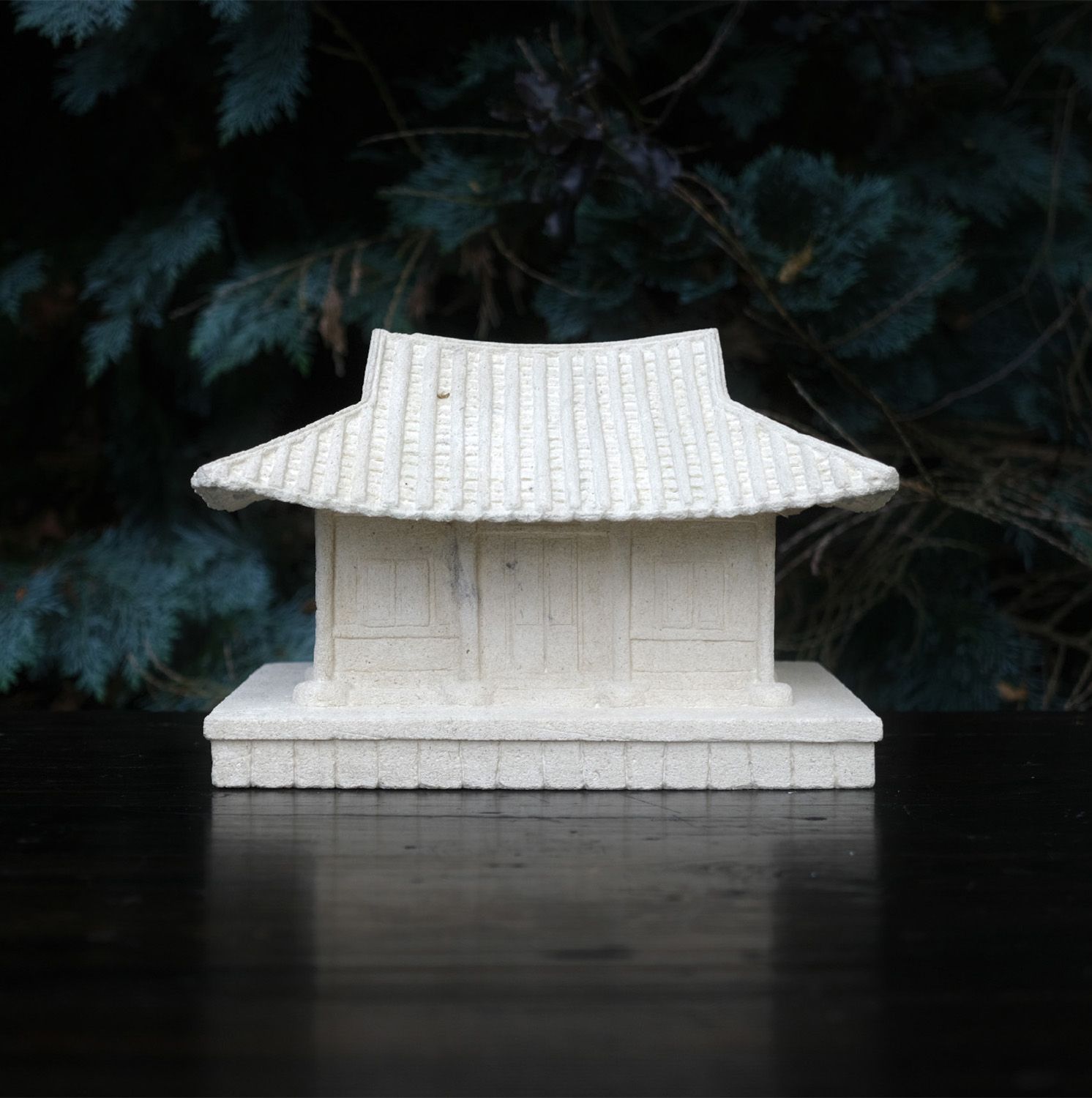
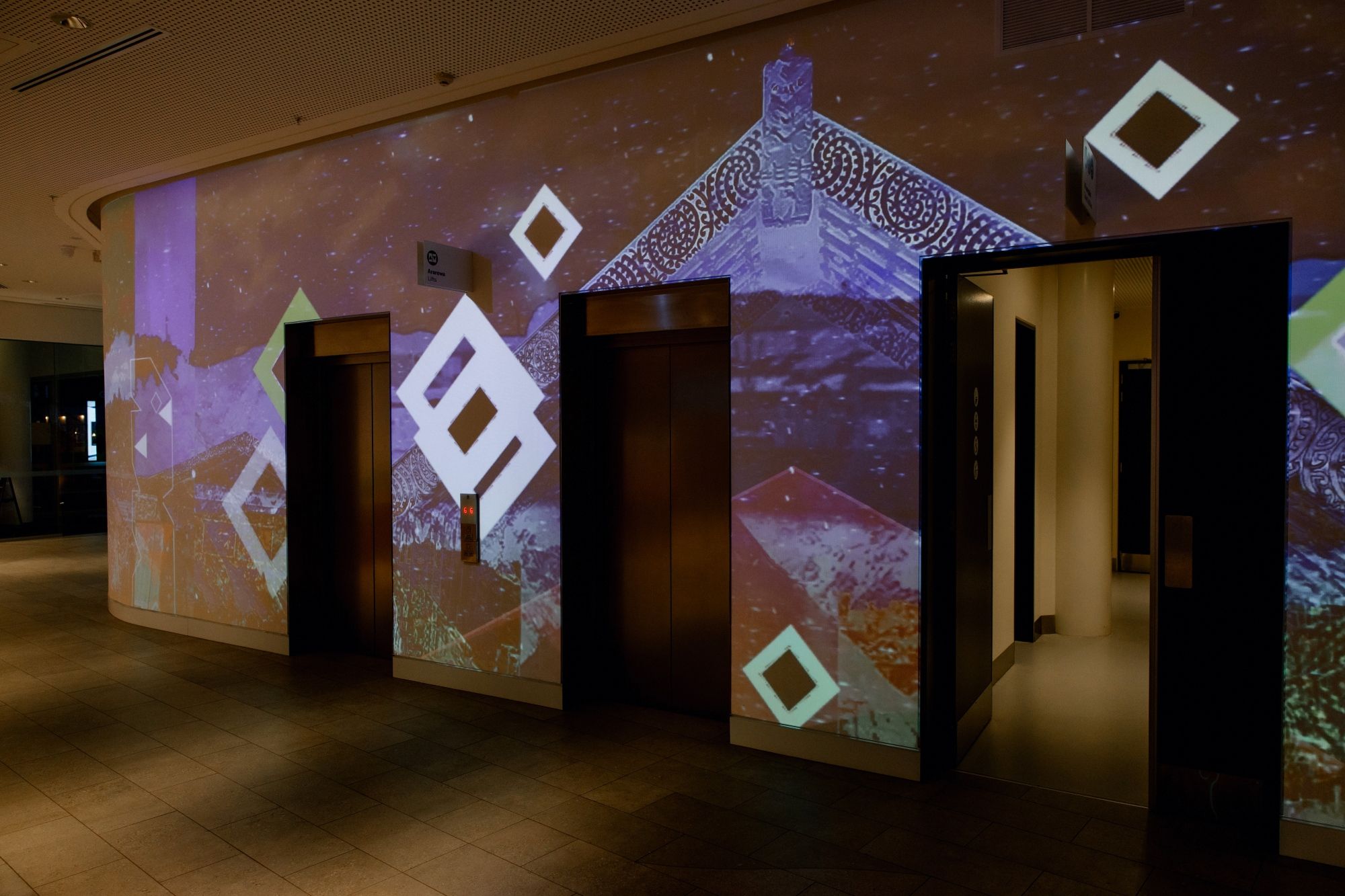
Steven Junil Park, Room (detail), 2023.

Photograph by Kelly Shakespeare

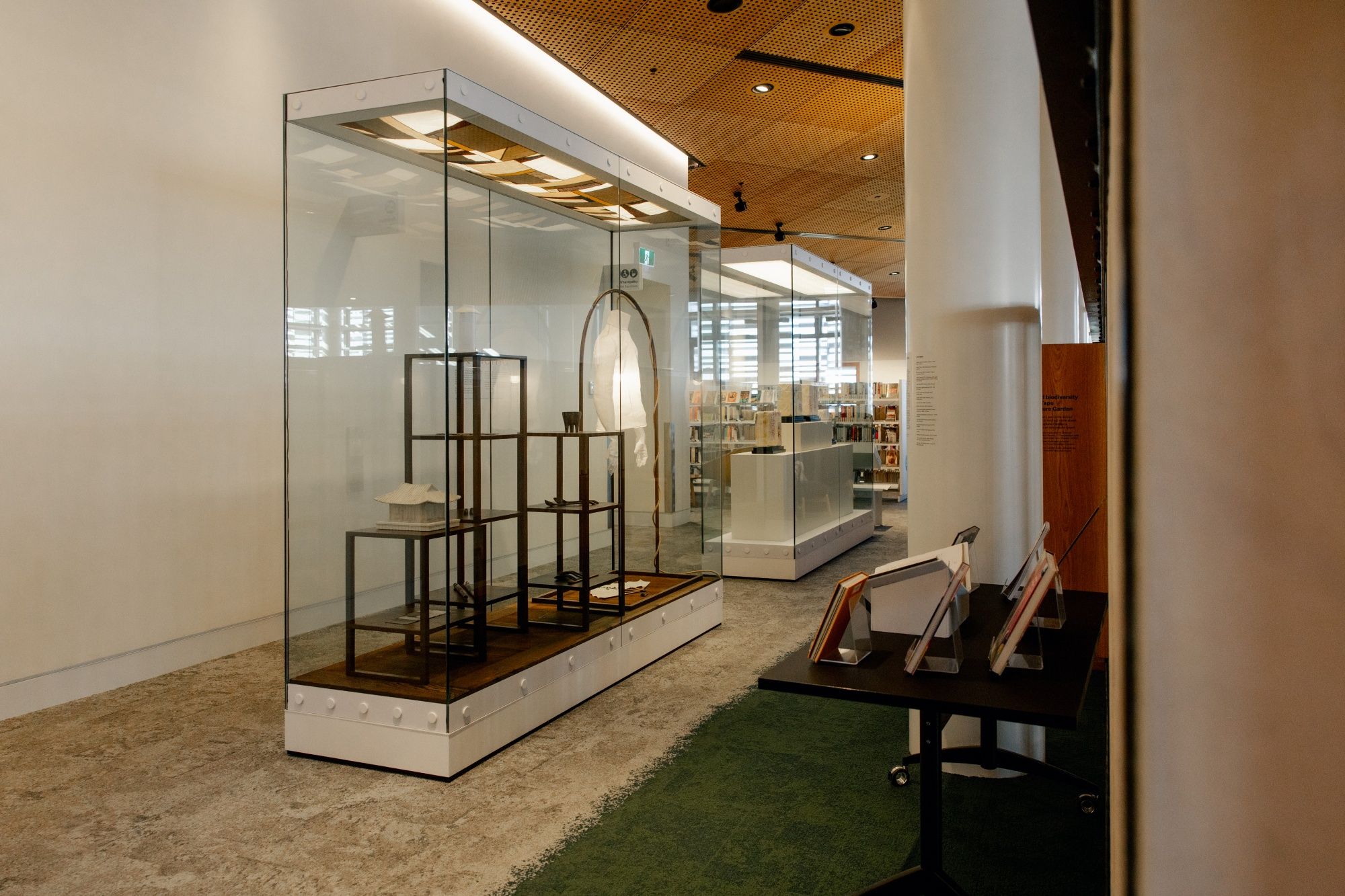
Steven Junil Park, Room (installation view), 2023. Mixed media installation.

Photograph by Mitchell Bright

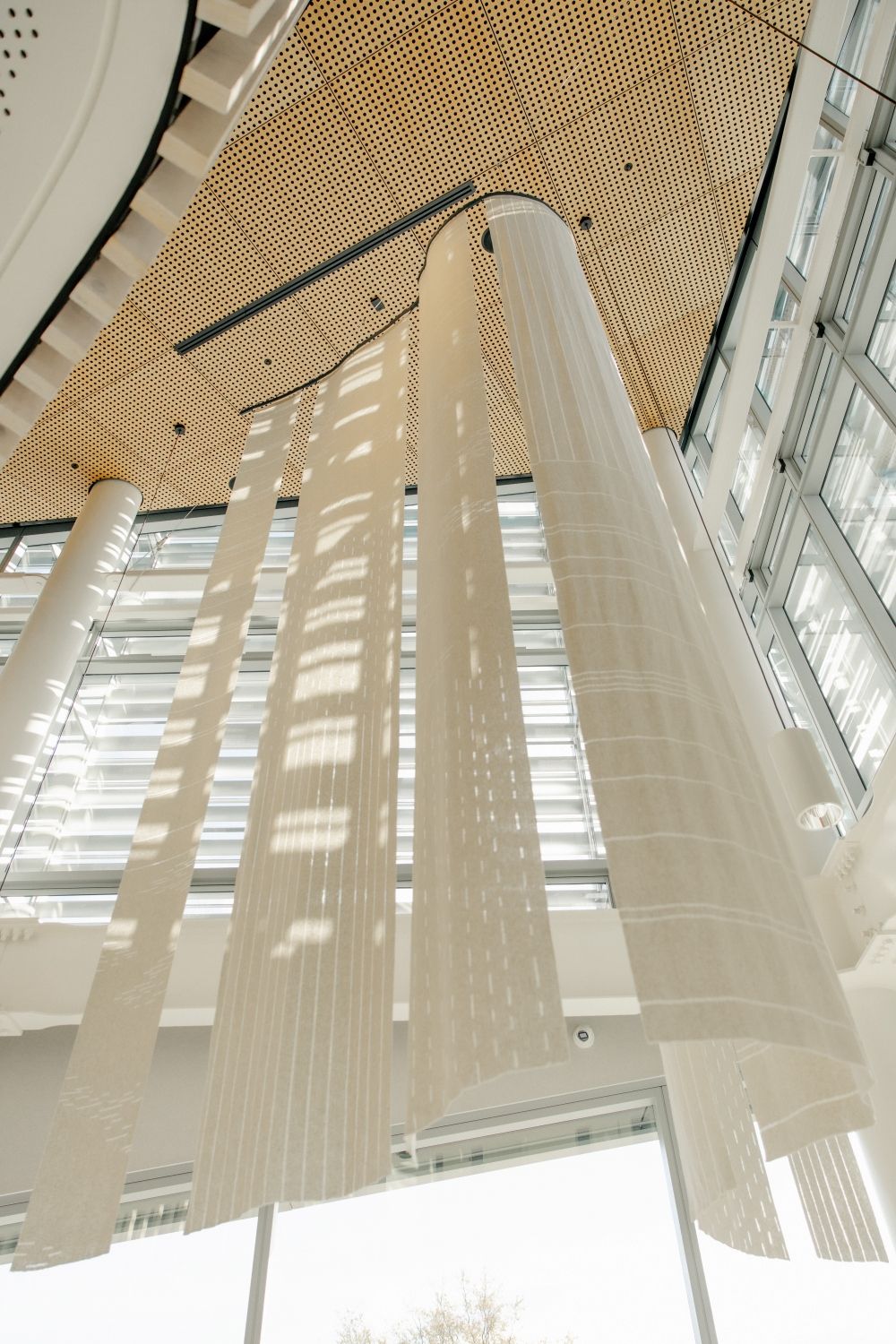
Megan Brady, Between tide and time (installation view), 2023. Steel, linen.

Photograph by Kelly Shakespeare

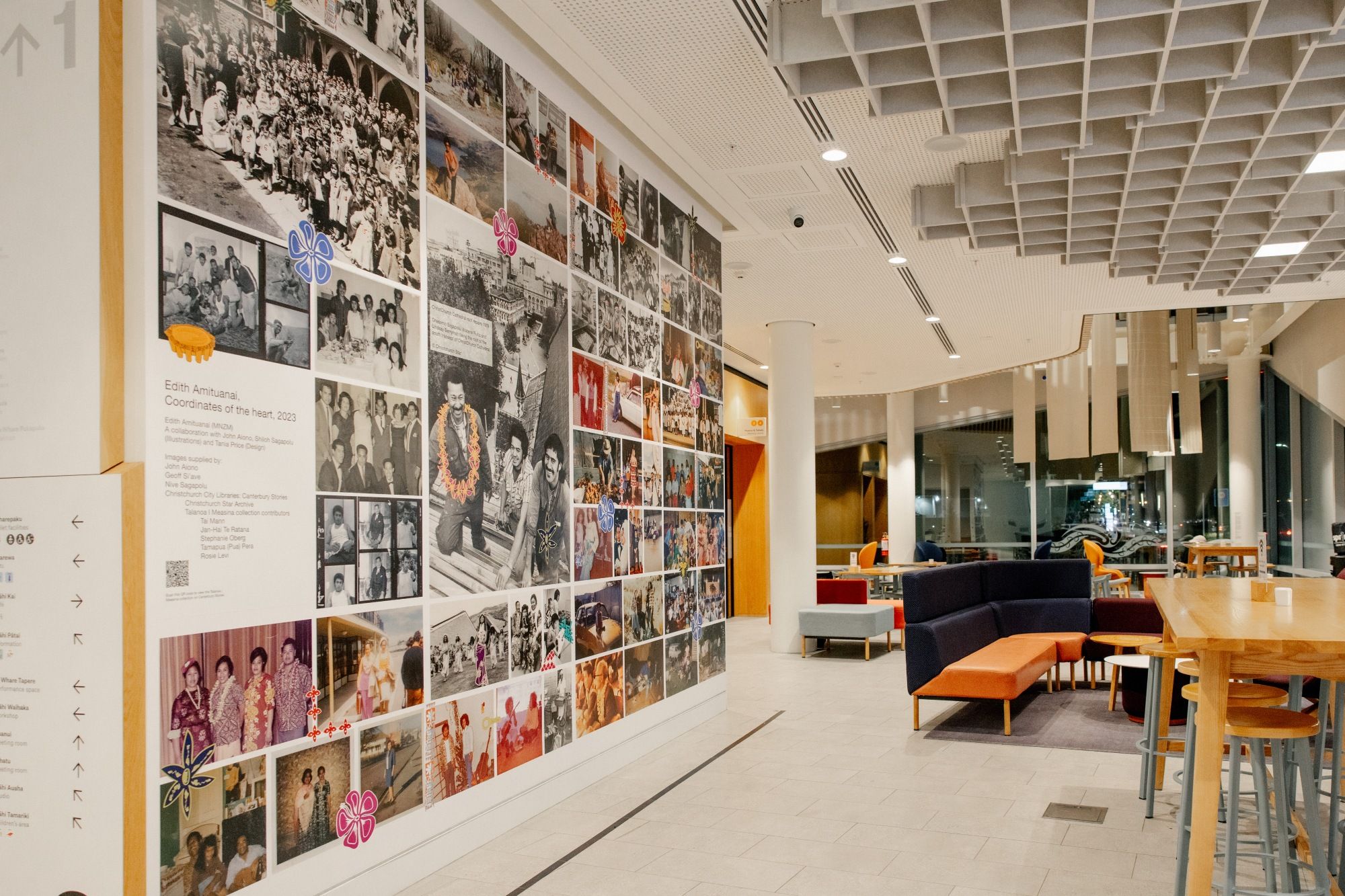
Edith Amituanai, Coordinates of the heart, 2023 (installation view).
Photographs from public and private archives, digital illustration, text, vinyl.

Photograph by Kelly Shakespeare

Jamie Berry,Kāinga Tipu (installation view), 2023. Digital video and soundscape (10 mins).

Photograph by Kelly Shakespeare

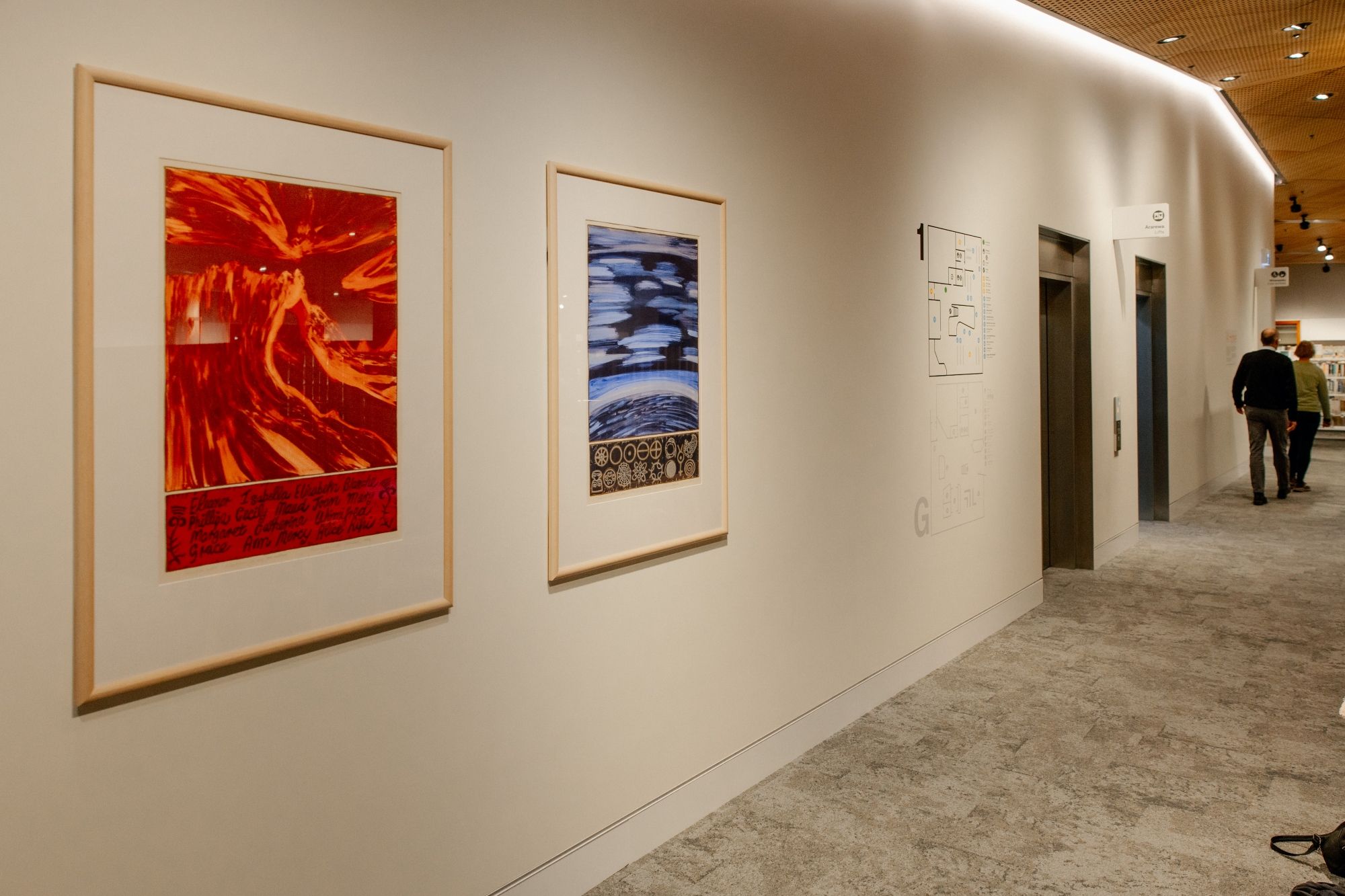
Marilynn Webb, Protection Work - Blue Night Ida Valley and Protection Work - Meditation for my Fore-Mothers (installation view), 1993. Monotype, wood block.

Photograph by Kelly Shakespeare

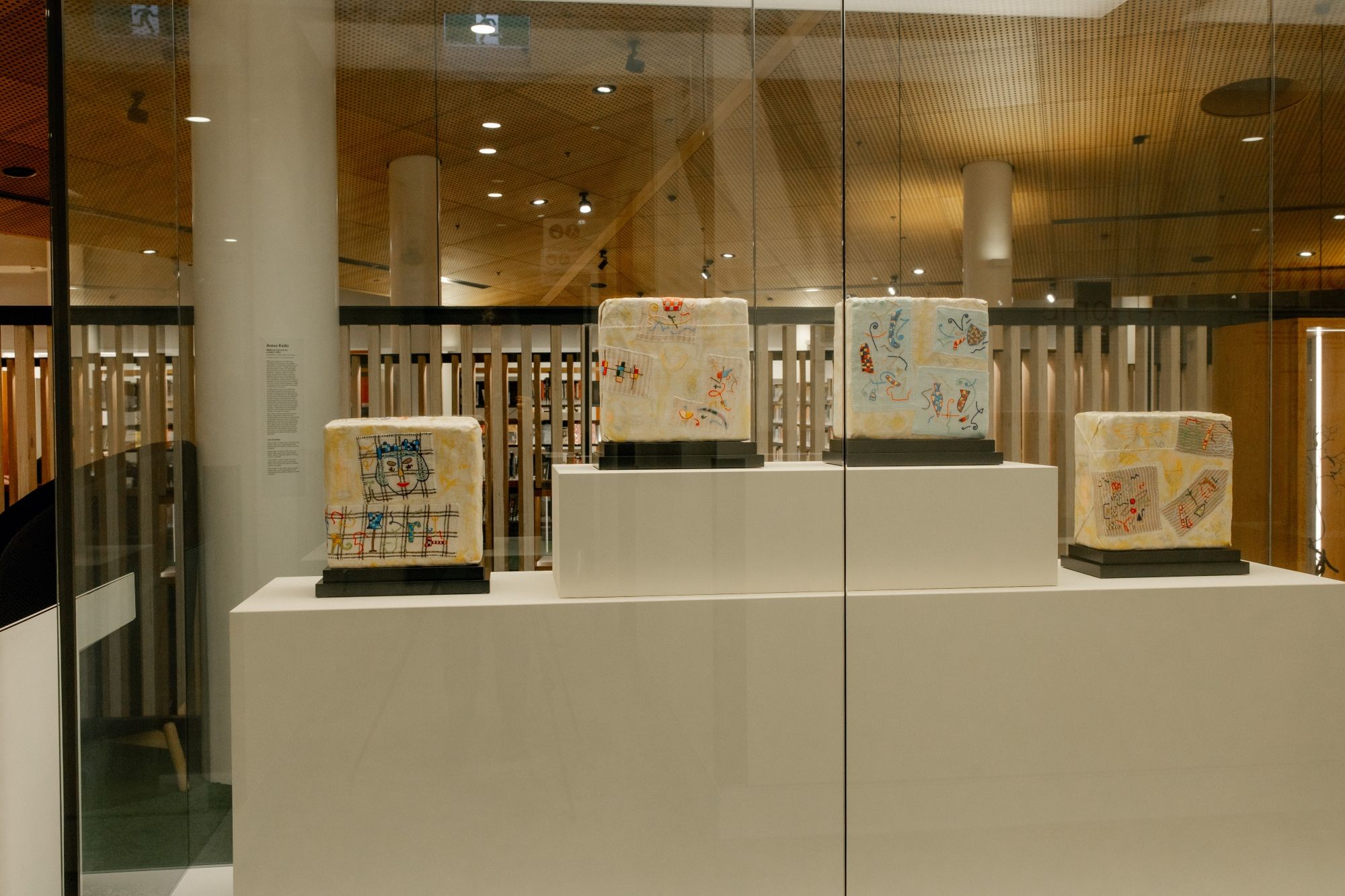
Areez Katki , Might we rest here for a while?, (installation view), 2023. Installation of adobe bricks and textiles.

Photograph by Kelly Shakespeare

At Home

What does it mean to feel at home? What does being at home mean for different people and communities? At Home delves into how we create a sense of home, presenting artwork by Edith Amituanai (MNZM), Jamie Berry, Megan Brady, Areez Katki, Steven Park with work by Marilyn Webb (ONZM) on loan from the Lincoln University art collection.

These artworks show us that there are many ways to make a home; from objects we use to furnish our houses, to the communities that support us, to the connection we have to the whenua and waterways that surround us, to ties that bind us home that is now far away. By sharing their stories of home, we can find similarities that connect us.

At Home explores what home looks and feels like for those of us who have made our homes together in Aotearoa New Zealand, Waitaha Canterbury, and here in Waikirikiri Selwyn.

Steven Junil Park, Room, 2023

Room, 2023
Steven Junil Park
Mixed media installation
Courtesy of the artist

For Ōtautahi Christchurch based maker, Steven Junil Park, feeling at home has never been straightforward. Growing up without positive representations of Asianness and queerness, Park handmakes his own objects to create a world where he feels at home. Park has said that growing up, he didn’t feel at home in his own skin as a New Zealander or being Korean. It’s a feeling he explores in Han (한), a hand sewn ramie hanging lamp that traces the shape of Park’s torso, neck, arms, and hands.

In Room, Park presents an interior referencing the architecture and furnishings of a 한옥 (Hanok), a traditional Korean house. The installation is grounded, physically and spiritually, by a wooden floor in the style of 마루 (maru) seen in Hanok. Three 사방탁자 (Sabang Takja), traditional shelves used to display objects in the home, support an array of Park’s making. Though the everyday pieces we live with are often overlooked, Park turns to them to reflect our shared human experiences.

By learning traditional Korean crafts, Park has connected with his heritage through a language of making that he is familiar and comfortable with. The patchworked textile that sits suspended over the installation references to 조각보 (Jogakbo), a traditional style of hand sewn patchworking that uses offcuts of fabric that he has saved from his studio over the years. In Room, Park’s jogakbo offers a soft and warm protective shroud. It creates a tender and sympathetic space for Park to create a home where he can be himself.

With thanks to John Harris and Picnic (Natalie Bascand and Rick Tapper)

List of works

Jogakbo patchwork, 2023. Cotton, linen, cotton thread.

Sabang Takja, 2023. Rosewood. Produced by Picnic.

Maru flooring, 2023. Canadian Oregon. Produced by Picnic.

untitled (hanok), 2023. Limestone, 24k gold.

Hand sewn Jogakbo coasters, 2020. Cotton, cotton thread.

Jesa Uipae, 2022. Ramie, cotton thread.

Hand sewn Jogakbo sample, 2020. Silk, silk thread.

Custom made index thimble, 2023. Sterling silver.

Custom made middle thimble, 2023. Sterling silver.

Long clay flute, 2023. Porcelain.

Medium clay flute, 2023. Porcelain.

Hand carved houhere greenwood three-legged bowl, 2023. Houhere.

Hand carved greenwood wide spoon, 2023. Houhere.

Hand carved greenwood quenelle spoon, 2023. Houhere.

Decorative comb, 2023. Recycled oak.

Han (한), 2022. Ramie, cotton thread. Ash stand produced by Picnic.

‘Han’ fan. 2017. Buried cotton, recycled kwila, brass, silk.

Megan Brady, Between tide and time, 2023

Between tide and time, 2023
Megan Brady (Kāi Tahu, Ngāi Tūāhuriri, Pākehā)
Steel, linen
Courtesy of the artist

Megan Brady is on a journey to reconnect with her home. After discovering her Ngāi Tūāhuriri whakapapa, she has been spending time on her tūrakawaewae in and around Ōtautahi Christchurch. Between tide and time considers the tide, which wraps around the coast from the Rakahuri Ashley awa to Taumutu, as a site of connection. This tide, Te Tai o Mahaanui, connects the marae of Ngāi Tūāhuriri to Ngāi Te Ruahikihiki ki Taumutu, mana whenua of Waikirikiri Selwyn.

The steel structure traces the distinctive curve of Te Pātaka o Rākaihautū Banks Peninsula and supports seven lengths of linen, suspended from tracings of pōhatu Brady collected along the shoreline. The six breaks between the fabric indicate where different hapū are located along the coast, a mihi to Brady’s whanauka and the interconnected network of Kāi Tahu hapū. For Brady, home is found in identity and connection with others, as well as a physical place.

The threads removed from the fabric create a repeating pattern which depicts the cycles of water. Beginning with the tide of Mahaanui, clouds form over the ocean and rain falls on the mountains before moving through the rivers and returning to the sea. This pattern was inspired by the poem ‘The River is an Island’, written by Hone Tuwhare, a favourite poet of Brady and her father. In Te Ara Ātea, Between tide and time ebbs and flows not with the tide, but with the changing sunlight and the movement of people who spend time with it.

Glossary of Māori terms

Whakapapa – genealogy
Tūrakawaewae - a place where one has
rights of residence and belonging through
kinship and whakapapa.
Awa – river
Pōhatu- rocks
Hapū - kinship group, subtribe
Mihi – Acknowledgement
Whanauka – relative, kin

With thanks to Te Tai o Mahaanui, Pete Brady, Brady whānau, Henry Francis, Puamiria Parata-Goodall, Denise Sheat, Chloe Cull, Ollie Roake, Bella Roake, Paige Jansen, Alix Ashworth, Ngaio Cowell, Orissa Keane, Ray Moreton, Steve Trevella, Rob Palmer, Peter Nock, Paemanu Ngāi Tahu Contemporary Visual Art

Edith Amituanai, Coordinates of the heart, 2023

Coordinates of the heart, 2023
Edith Amituanai MNZM
In collaboration with John Aiono, Shiloh Sagapolu, and Tania Price
Photographs from public and private archives, digital illustration, text, vinyl
Courtesy of the artist

Family photo albums don’t just capture our family and friends, they also document our communities. In 2015 John Aiono and Geoff Si’ave contacted photographer Edith Amituanai on Facebook to ask if her father was Onesemo Sagapolutele. They were trying to identify people in a photograph taken in 1967 outside St Paul’s Trinity Pacific Presbyterian Church, a hub for the Pacific community in Ōtautahi Christchurch. Amituanai calls this photograph the genesis image for Coordinates of the heart.

This archive traces early Pacific migration to Ōtautahi Christchurch, beginning in the 1960s. Amituanai’s own parents, Nive Tuilaepa and Onesemo, met here after migrating from Samoa in the 1970s. Coordinates of the heart pieces together the community they were a part of before they moved to Tāmaki Makaurau Auckland where Amituanai was born. It maps Pacific lives and experiences across Waitaha Canterbury, including landmarks like the Christchurch Cathedral and the Port Hills, community hubs like the Woolston Working Men’s Club, and further afield, with the 1978 St Paul’s Autalavou picnic in Glentunnel.

The images were sourced from personal collections as well as the Christchurch Star Archive and the Talanoa I Measina collection publicly housed on Canterbury Stories, the digital repository of Christchurch City Libraries. Digital illustrations adorn the photographs as interventions that inject colour and vibrancy. Amituanai likens the illustrations to putting a lei on the photographs, a gesture of respect and alofa. They weave in and out of milestones like birthdays, weddings, parties, and festivals; the shared experiences that build a community. As Amituanai says, ‘these are the things that become home to you.’

Glossary of Samoan terms

Autalavou - youth
Lei - garland
Alofa - love

Images supplied by:
John Aiono
Geoff Si’ave
Nive Sagapolu
Christchurch City Libraries: Canterbury Stories
Christchurch Star Archive
Talanoa I Measina collection contributors:
Tai Mann
Jan-Hai Te Ratana
Stephanie Oberg
Tamapua (Pua) Pera
Rosie Levi

Jamie Berry, Kāinga Tipu, 2023

Kāinga Tipu, 2023
Jamie Berry (Ngāti Porou, Te Aitanga-a-Māhaki, Rongowhakaata, Ngāti Ruanui, Ngapuhi)
Digital video and soundscape (10 mins)
Courtesy of the artist

Kāinga Tipu is an immersive multi-media work which explores the call home and the act of migration. The video recounts the connection between Jamie Berry’s East Coast Ngāti Porou tīpuna, and Ngāi Tahu. In Ngāti Porou traditions, Tahupotiki, who Ngāi Tahu takes their name from, was the brother of Porourangi, the ancestor of Ngāti Porou. In Kāinga Tipu a scarlet sky references this connection; Porourangi was born in the crimson, red-tipped dawn and Tahupōtiki’s birth was in the evening flushed red with the setting sun.

A kāinga tipu is an ancestral home. Berry’s motifs speak to this tūrakawaewae, a place of grounding, for those who find home on new horizons while holding fast to past groundings. Berry lives away from her kāinga tipu, Rongopai Marae in Tūranganui-a-kiwa. She knows that sometimes our memories of home become faded, and our links feel severed. In Kāinga Tipu Berry reminds us that our tīpuna are always with us, so we are always home.

The soundscape which accompanies the video is structured around Berry’s DNA. The chromosome sequences are coded to recordings of nature and taonga puoro. With her DNA connecting her to her tīpuna, the sound gives a direct connection to wairua, to the past, present, and future. Alongside her tīpuna soundscape, Berry pairs the landscapes and imagery of her kāinga tipu. In this layering Berry creates the call of a virtual tūrakawaewae, a home away from home, a place to be and remember, to connect and ground.

Glossary of Māori terms

Kāinga tipu - ancestral home
Tīpuna - ancestors
Taonga puoro - musical instrument
Wairua - spirit

Marilynn Webb, Protection Work - Blue Night Ida Valley and Protection Work - Meditation for my Fore-Mothers, 1993

Protection Work - Blue Night Ida Valley, 1993
Protection Work - Meditation for my Fore-Mothers, 1993
Marilynn Webb ONZM (Ngāti Kahu, Te Roroa, Pākeha)
Monotype, wood block
Courtesy of the Lincoln University

When Marilynn Webb made Dunedin her home in 1974, landscape painting was well established within New Zealand art. However, Webb’s prints presented a different lens to see our environment through, one that connected to an emotional and spiritual experience. While working as Tovey Scheme art advisor in Northland, Webb said she ‘became very interested in the whakapapa of land and Papatūānuku and the stories attached to the land.’

Her series Protection Works evolved out of this interest. The Ida Valley in Otago became a focus of her prints after she purchased the old Ida Valley Hotel in the 1980s. Beneath the racing sky of Protection Work - Blue Night Ida Valley, Celtic symbols refer to the elements of water, earth, fire and air. In Protection Work - Meditation for my Fore-Mothers, Webb lists her maternal ancestors, women who believed in the preservation of the land. Webb’s inheritance can be seen in the swathes of red and blue which take on the role of shield in what Webb called, 'force fields of colour.’

Prints such as these had a purpose. Webb wanted us to find a home in our environment, to connect with it as both a physical and spiritual entity. As arts writer, Bridie Lonie summarised, Webb worked ‘to remind people of the importance of the landscapes of the heart, to record places which will not remain the same for long, and to create images which hold local histories.’

With thanks to Fiona Simpson

Glossary for Māori Terms

Whakapapa - genealogy
Papatūānuku - Earth mother

Areez Katki, Might we rest here for a while?, 2023

Might we rest here for a while?, 2023
Areez Katki
Installation of adobe bricks and textiles
Courtesy of the artist and Tim Melville Gallery

Might we rest here for a while? is an installation that explores Areez Katki’s experience of being disconnected from the land of his ancestors. Though Katki now calls Whanganui home, his whakapapa connects him to the Persian Zoroastrian diaspora. A diaspora refers to a large group of people who share a cultural or regional origin but are living away from their homelands. Katki is also alienated from Zoroastrian material culture which is housed in museums around the world like the Louvre and the British Museum. These remnants of home are largely inaccessible for the Parsi community.

In *Might we rest here for a while? *hand embroided drawings depict fragments of stolen artefacts and rare depictions of women in Achaemenid art. The cloth itself is sourced from family archives: clothing and the residues of domestic life. They envelop parcels of whenua fashioned into adobe bricks. Adobe bricks are made with an ancient earth-binding technique using mortars of clay, sand and straw exposed to sunlight. These bricks were the building blocks of the Zoroastrian Achaemenian Empire in the late-4th century.

Here, they stand as remnants of ancient Persia, presented on plinths like the museum held artwork that are embroidered on the fabric that covers them. They are addressed to members from Katki’s small Parsi community; his grandmother Thrity, his mother Yasmin, his sister Delzin and himself. Might we rest here for a while? offers these small blocks of earth to hold, land from a new home for a people who have become landless through migration and exile.

List of works

Areez Katki, To Thrity, 2021. Clay-rich earth, straw, cotton duck, embroidered khadi, natural pigments (saffron, barberry, sumac), oil pastel.

Areez Katki, To Yasmin, 2021. Clay-rich earth, straw, cotton duck, embroidered khadi, natural pigments (saffron, barberry, sumac), oil pastel.

Areez Katki, To Delzin, 2021. Clay-rich earth, straw, cotton duck, embroidered khadi, natural pigments (saffron, barberry, sumac), oil pastel.

Areez Katki, To Self, 2021. Clay-rich earth, straw, cotton duck, embroidered khadi, natural pigments (saffron, barberry, sumac), oil pastel.